
Let’s play…horrible hypotheticals
However bad it can get, it can always get worse. And rising trade tensions among regional superpowers might presage a far more complicated landscape for retail.

It occurred to me the other day that there must be people among the highly-intelligent and perspicacious band that are Retail Slop subscribers who await each missive from this Substack with foreboding.
Whenever the latest screed pops up on the phone or lands in the inbox, they probably think: what new industry upheaval has dropped today? And, to them, I can only apologise. One of my mission statements here (in as much as I actually have a mission) is to try to address industry developments with both analytical depth while attempting to avoid the more po-faced neutrality that often characterizes much of modern retail insight.
It’s not always an easy task, especially when many of the major decisions that have far-reaching ramifications for retail tend to be made by those guided by little more insight than the voices in their head. As I’m putting the finishing touches to today’s piece, I see another tranche of tariffs have dropped with ‘forced labour’ the supposed rationale.
I already had today’s topic outlined in my head and, yesterday, sat down to get into it. As usual, this was prefaced by a cursory glance at the latest news. The first thing I saw was that the European Commission had hit Google with a USD1 billion fine for two violations of the Digital Markets Act.
For an earlier examination of US-EU trade tussles, go here.
Not going to lie—my heart skipped a beat. Not because I’m anti-Google or anything, but because this kind of thing represents exactly what I was planning to discuss. Because you see, in my semi-official role as the Retail Prophet of Doom™ (patent pending), there’s a whole cluster of converging threads coalescing and where they meet looks, well, frankly rather messy and complex for the industry.
Tech tensions are ticking up
It’s been happening almost under the radar up until now, but I believe we’re beginning to see a situation where tech platforms likely to be the bedrock of future retail are becoming geopolitical assets. We’ve touched upon this here before, but recent escalations have pushed the subject much more into the mainstream debate. And given the present attitudes of the primary parties involved, it’s difficult to see this resolving in ways that benefit businesses caught in the middle of a more substantial political squabble.
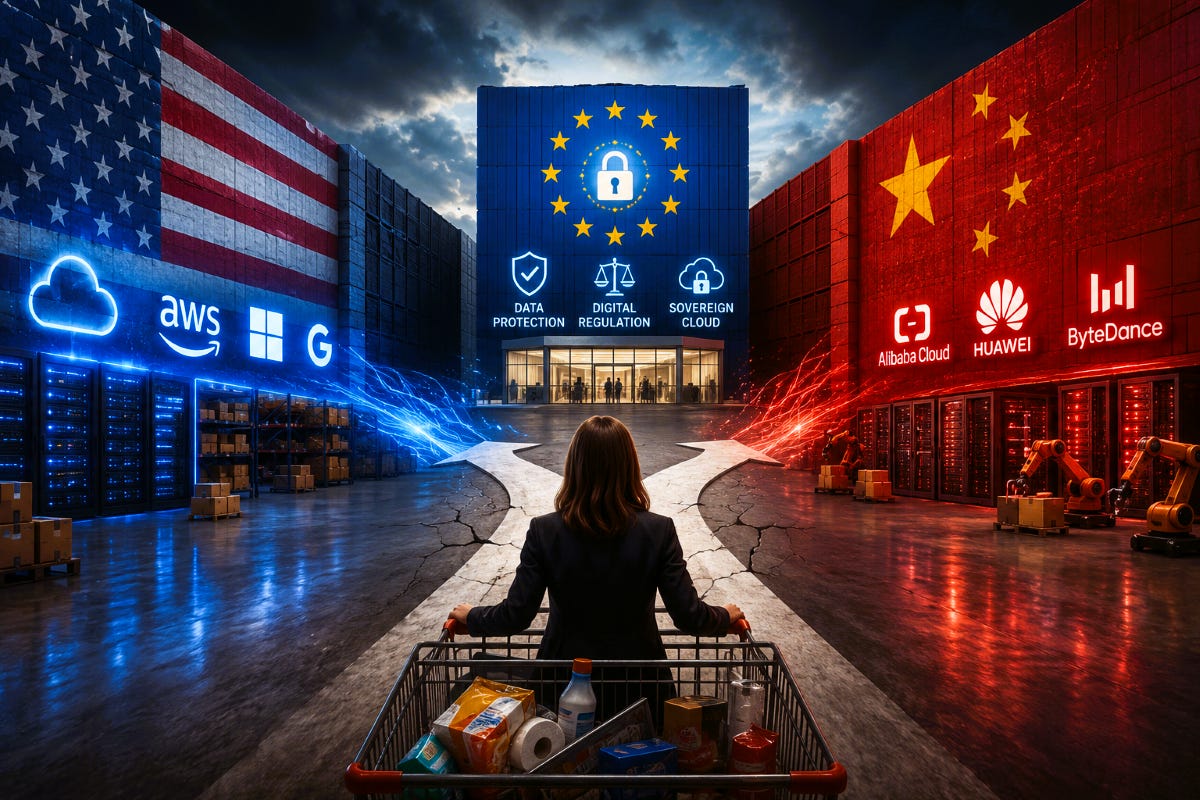
Let’s lay out the basics of where we are right now. One the one hand, we have the US administration which is, for good or for ill, very tightly bound to its homegrown tech entrepreneurs, especially those in AI. Then we have China, whose tech sector has been building its own LLMs and achieving similar outcomes. Caught in between we have Europe, which has only recently realised it perhaps needs to limit its exposure to both. The rest of the world, for the time being, we can describe as interested bystanders.
It’s perhaps been clear for a while now that moves away from globalism towards multipolarity have been in train for several years. This has only accelerated since the advent of the Trump Years, marked by insularity, attempts at protectionism, tariffs and all the other measures designed to unfriend and disinfluence people. China, as we’ve stated here many a time, is steadfast in its embrace of globalism. After all, it manufactures tons of stuff and needs to sell it somewhere.
Understand how China took advantage of US trade moves here.
Europeans, though, currently find themselves caught betwixt and between. It remains beholden to US tech for the bulk of its business and administrative processes yet is no longer entirely trustful of its transatlantic partner. It has been attempting to hedge against this relationship by forging stronger ties with China, now widely viewed globally as a more reliable and stable partner, only to find this relationship fraying as it tries to temper what it perceives as excessive or irregular practices by some of its largest online operators.
Uneasy alliances and outright opprobrium
This tension has been there for years. Particular flashpoints have come and gone, like GDPR, digital taxation, fears raised over Huawei or TikTok. These, though, were largely isolated cases. What we’re seeing now is a more intense argument building around who will control technologies on which modern economies will depend.
For retail, this quickly shifts from a hypothetical head-scratching exercise to a highly real and visible one. Consider just how many retailers worldwide rely massively on US firms like Microsoft, Google Cloud, AWS, Salesforce, Oracle and SAP (technically European but globally integrated).
These businesses have enormous weight in everything from advertising to warehousing to CRM and beyond. Whether a retailer is based in Berlin, Bangkok or Bangalore there’s a high probability one or more of these play an integral role in your company’s success. Almost every major retailer now operates on a technology stack assembled from dozens of international providers.
It’s a state of affairs that’s functioned fine for years. We’ve all assumed these systems will always be available because it’s a win-win for all concerned. But what if that were to change?
The rhetoric ratchets up
Earlier this week, a group of Congressional Republicans urged President Trump to instigate trade investigations against the EU over its regulation of US tech. They accused the EU of economic extraction and regulatory coercion, suggesting that EU access to the US market shouldn’t be taken for granted. In that light, the EC bumper fine of Google couldn’t have been worse timed and will only likely ramp up antagonism between Washington and Brussels.
At the same time, decidedly bad vibes are flowing across the Pacific, too. US AI firms are ramping up calls for harsh crackdowns on Chinese LLMs, accusing them of distilling models like Anthropic’s Fable to produce their own versions. These accusations have been echoed by senior US government figures, setting the stage for a scenario where potentially US firms are banned from using Chinese LLMs.
All this arises as the introduction of token-based billing has led many companies around the world to turn to lower-cost Chinese solutions, something that might put the business models of US hyperscalers in danger. Of course, more cynical observers haven’t been slow to point this out, arguing that this is just another facet of protectionism. But the real danger could be something worse: technology fragmentation on geopolitical lines.
US Secretary of State Marco Rubio has told diplomats to push back against digital and AI sovereignty initiatives from foreign authorities. This came after the US temporarily blocked foreign access to two of Anthropic’s most advanced AI models. Washington tried to play down any talk of a “kill switch”, but the incident has raised alarms in many nations as to the potential for tech to be weaponized.
That has seemingly prompted Beijing to consider comparable moves, with Alibaba, ByteDance and Z.ai called in for discussions about more rigour around foreign access to advanced models, training data and chip technologies. It has worrying echoes of the paranoia of the Cold War era, with AI being regarded more like an of element of national defence than simply software.
The EU’s Cloud & AI Development Act, meanwhile, seeks to build some kind of bulwark against any superpower machinations. It looks to triple data centre capacity by 2033, while tech-sovereignty measures cover semiconductors, AI, Cloud services and open-source software.
Can we avoid the chaos?
But all these manoeuvres can’t override essential facts. None of these powers can realistically achieve technological self-sufficiency as yet. The US is dependent on Asian semiconductors and European chipmaking equipment. China needs access to advanced GPUs. Europe wants badly for homegrown options across Cloud, software and frontier AI.
But if the bellicose tone worsens and we start seeing barriers erected, that’s when fragmentation might become an issue. Retailers could potentially have to navigate a maze of technology environments. And it could only get worse if we see a recurrence of the 2020 Huawei panic where it wasn’t so much down to one operator or another using a certain technology but down to the origin of components in the tech.
We could see scenarios where a US-origin AI is barred in China and also needs a Europe-exclusive compliance process. A multinational retailer might have to deploy different recommendation models, customer-service tools and product-content systems in each operational region. Data storage and processing may have to be devolved to country-level management over privacy concerns.
You can see how this can all get very messy very quickly. Payments fragment around different digital ID systems, local networks and central bank currencies. App-store requirements and digital advertising rules could diversify. That connected car, warehouse robot, in-store technology you’re using? Well, it probably requires different security certification depending on where it’s deployed.
Semiconductors could be a real headache. Retailers mostly give these little thought on the day-to-day, but they’re everywhere across their operations. Chips are in the scanners, cameras, temperature controls, delivery vehicles and DC automation. If regulatory measures begin classifying ‘hostile foreign influence’ as being determined by whether the chip in that ESL originated in Taipei, Texas or Tianjin, then we’re in real bother.
And let’s not even start to think of the expense involved. Retailers would have to manage multiple infrastructures, localise data and boost hiring to oversee regulatory and cybersecurity differences. Cost savings generated by harmonising global systems would evaporate overnight.
Local Cloud providers, systems integrators, cybersecurity firms and regional software devs could be big winners in this version of the future. Open-weight AI models would be even more sought-after, not just for being cheaper but because businesses can self-host and shift them between infrastructure providers as needed.
A call for clear-headed thinking
The real hope, of course, is that cooler heads prevail and the adults in the room prevail. Unfortunately, those seem in short supply of late. Recent weeks have seen a return of the ‘Red Scare’ language last seen in the 1950s, with Trump and his acolytes warning against the pernicious rise of communism. Trump himself directly blamed China (without any proof) for influencing his 2020 election defeat. If we’re looking for signs of calmer Sino-US relations, these aren’t ideal augers.
Of course, as with many things since January 2025, this may all be bluster and swiftly forgotten when cold, hard business calculus comes into play. But such is the volatility and unpredictability in the White House these days (just ask Canada), it’s nigh on impossible to predict with confidence what this administration will do next.
AI could be the trigger for a new round of trade restrictions, embargos and complications centred around whose technology is in what products or devices. For the retail industry, it could pose increasingly tricky questions in the months and even years ahead.
Would you go with a Chinese automation vendor for your Cloud-based supply chain upgrade project—even though they’re cheaper and a more efficient solution—if, by deploying that tech, the products you make using it are excluded from the US market as a result? That might sound far-fetched, but guess what, that actually happened just a day or so ago.
I find it hard to envision a world one day divided into US, European and Chinese technology blocs. Commercial self-interest will always bend towards interoperability. Besides, no government on earth is capable of replicating the entire global technology supply chain by itself. However, assuming the best technology will always be available in every market is beginning to look like a fragile notion.
If you found this content useful, be sure to subscribe free to Retail Slop on Substack for regular updates and insights on developments across the retail world. You can also support this blog’s work via a paid subscription if you so choose, which would be super-nice!