

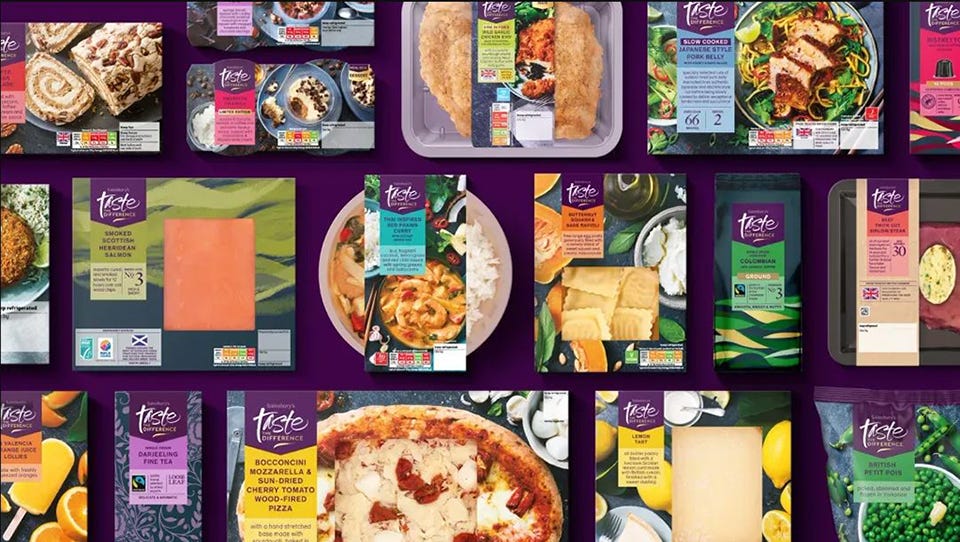
(Source: BrandMe)
It’s been another red-letter year for private label sales, and news last week only confirmed how house brands are reshaping planograms worldwide. In the UK, Worldpanel predicted that premium own-brand sales, spearheaded by brands like Tesco Finest or Sainsbury’s Taste The Difference, are set to hit GBP1 billion by December, the first time this tier has reached that level.
Across Europe, retailers have been quietly building premium tier labels that feel and behave more like classic manufacturer brands, only with sharper value and tighter integration into the wider proposition.
Shoppers seeking affordable excellence
As Europe’s biggest market, Germany is a useful place to start. In December 2024, agency Oliver Wyman revealed that 41% of shoppers had switched preference from manufacturer brands to private label in the 12 months to 2023, with a further 20% saying they were considering doing the same. Meanwhile, researchers at GfK said private label value share climbed from 40.6% to 45.5% between 2021 and 2023, representing a new high as well as an acceleration in own-brand uptake.
Within that surge, retailers have been consciously extending into higher-quality ranges. Organic and regional lines like Naturgut at Penny and Edeka Bio are examples of how operators are using sustainability and provenance to add a premium gloss to own label propositions.
Premium ranges like Rewe Feine Welt and Aldi’s Gourmet banner have also succeeded in garnering more share, as shoppers used them as affordable substitutes for restaurant meals or branded treats. This is, of course, very much a lend from the UK private label architecture that has been very much the pacesetter in how European retail approaches own-brand strategy in fully mature markets.
Another Wyman study suggested 89% of German consumers saw no material quality difference between retailer and manufacturer brands. Consumer organisation Stiftung Warentest reached similar conclusions across more than 1,400 comparative product tests, finding that store brands often matched manufacturer lines on taste and safety while remaining roughly 35% cheaper.
At the same time, market researchers pointed out that some premium private label lines now sit at or above the price of comparable branded goods, which underlines that this is no longer a pure discount play but a value-for-quality equation.
Data from the GfK Consumer Index for H1 2024 offered some numbers around the trend. Analysts said premium private label ranges delivered sales growth of 14.7% year-on-year, making them the fastest-growing tier, while entry-level private label lines, which had been the big winners in 2022 and 2023, grew by only 2.3%.
Building on well-based behaviours
Overall, German private label value share was said to be broadly stable, yet premium ranges still added 0.5pp of market share, while entry-level tiers lost 0.6pp. In other words, the story is about mix rather than mass, with shoppers trading up inside own label. And retailers have been working hard to encourage this behaviour, with aggressive promotions of premium house brands, often linked to loyalty incentives, increasing over time.
A shopper study from Simon-Kucher in December 2024 found that half of Germans already chose private label predominantly or almost exclusively in supermarkets and drug outlets. Price was still cited by 60% of respondents as the main reason, but 37% pointed to quality and 30% to sustainability, with younger shoppers especially likely to mention the latter.
For insight on private label growth in good-for-you categories, read the Retail Slop piece here.
Premium own label is not just an in-aisle phenomenon, it is also becoming a force online. Euromonitor estimated that the top 100 FMCG brands now account for 21% of global FMCG ecommerce value, and said that 19 of those brands are retailer-led private labels.
Together those retailer brands were reported to generate around 25% of the ranked brands’ online sales. Banners such as Walmart’s Great Value, Tesco Finest, M&S, Member’s Mark and Kirkland Signature were highlighted as examples of house brands that have built premium or near-premium positions by combining quality with the reach of large omnichannel ecosystems.
In the UK, the premium lens is showing up in weekly numbers. NIQ data for the four weeks to 1 November 2025 released last week showed that shoppers were economising on out-of-home occasions rather than cutting back at the supermarket, and that many were opting instead to dine in.
Their view was that this would favour premium private label food and drink over the next few weeks, particularly at banners such as M&S and Waitrose, but also in the finest and luxury tiers at Tesco and Sainsbury’s. It’s likely no coincidence that last month Sainsbury’s unveiled its Taste The Difference “Discovery” range specifically targeting at-home dining occasions. The timing here is obvious—top-tier own brands have come into their own at Christmas in recent years with households wanting something extra-special that won’t overly extend their budgets.
Getting a grip on own-brand growth
Examples from Spain show how far models can stretch when private label more or less becomes the default. A June 2025 study from Kantar Worldpanel Spain said retailer brands had grown share from 27.2% to 43.7% over the past 15 years, and projected they could account for 70% of FMCG categories by 2035.
Spain was described as seeing private label penetration now close to 50%, driven primarily by discounters like Lidl, Aldi and Dia and also by market leader Mercadona, which has built almost its whole offer around own label. Kantar’s analysts argued that assortment strategy was now crucial. They found that categories where SKU counts increased by over 5% boosted penetration by 22% and volume by 28%, with much of that incremental space being deployed to build out differentiated, often more premium, private label offers.
Inflationary spikes following Covid may have spurred more shoppers towards private label, but premium ranges are helping to cement those behaviours. Shopper data collection has become far more granular in recent years, particularly with the advent of loyalty programmes, and this deep knowledge of purchasing patterns is helping inform own-brand development at the expense of A-brands.
Innovation and novelty are now the hallmark of private label rather than manufacturer brands. Retailers are far more prepared to flex into new cuisines and flavours to attract shoppers than multinational FMCGs that are more focused on sustaining category volumes across multiple markets. Exotic flavour combinations are more likely to surface within a retailer’s own-label range than among the branded supplier proposition, where the urge is more to create products that work across a wider range of geographies and channels.
Will the trend go global?
Today, retailers are very much deploying private label as a strategic asset rather than merely a margin lever, and are making significant investments in innovation, sustainability and distinctive positioning at the top end. This is bad news for manufacturer brands, who have to find ways to meet the challenge.
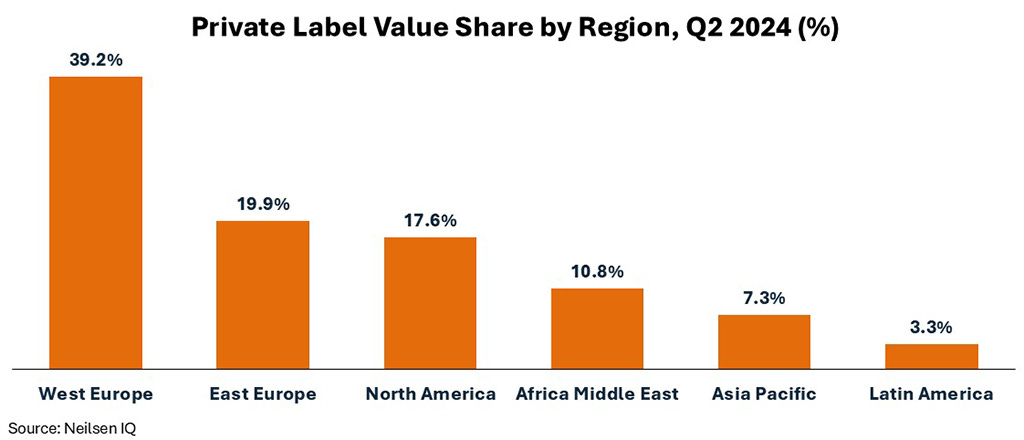
Of course, FMCGs will point to the widely variable levels of private label penetration worldwide and this cannot be ignored. Europe own-brand share averaged ~40% as of H1 2024, but was only 17.6% in North America and as low as 3.3% in LATAM, per NIQ data. But we only have to go back 20 years to discover European private label share standing at just 23% of value sales to understand how quickly uptake can snowball once retailers crack the code on what brings shoppers to house brands.
Macroeconomic circumstances and private label uptake typically align. Own-brand sales showed a marked spike after the 2008 financial crisis steered more consumers towards discounters and received another boost following the pandemic. With US shoppers currently struggling with mounting grocery inflation and rising household expenses, we anticipate more moves from major players like Walmart and Kroger to build out their in-house propositions across tiers, likely taking cues from their European peers.
If you enjoyed this content, be sure to subscribe free to Retail Slop on Substack for regular updates and insights on developments across the retail world.