
Zero-checkout is finally finding its retail role
Autonomous outlets were once the future. A few bruising years later, formats are more focused and designed to fill specific gaps rather than replace traditional retail altogether.

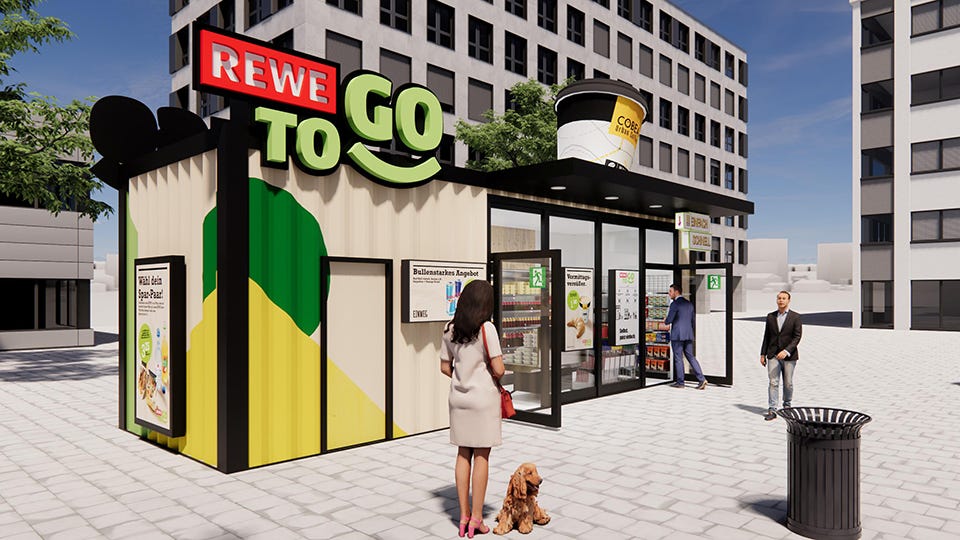
(Source: Rewe)
Autonomous retail has come a long way from the excitement of Amazon Go’s 2018 launch in Seattle. That first convenience outlet in Seattle promised a new era and everyone in the business was transfixed with excitement at the prospect.
Analysts are always fond of using the word “game-changer”, but this time it really did feel this justified the term. Remember, seven years ago Amazon was genuinely shaping retail evolution and it felt like every innovation was just another point on its way to total world domination.
I mean, this was truly the consumption of tomorrow back then. You scanned a QR code, picked up your items and walked out while the system charged your account automatically. Consumer convenience taken to new heights, we all opined—how could it fail?
All aboard the bandwagon
The concept triggered a rash of imitators, most notably in China. Tech groups, ecommerce giants and startups raced to open their own iterations of unmanned outlets, deploy hi-tech vending devices and insist they had cracked the code of the future of grocery.
Alibaba pushed Tao Cafe, JD.com opened camera-filled convenience units and dozens of new operators appeared with valuations running into tens of billions as investors threw cash at what seemed to be a bet that couldn’t lose. The maths made complete sense—everyone involved in retail knew how staffing costs reduced sales per square metre equations, so stores minus labour had to be a win-win, right?
Fast-forward a few years and the picture was different. September 2025 saw Amazon confirm the closure of its final UK Amazon Fresh unit using Just Walk Out technology. The first UK site in Ealing opened in 2021 and was intended as the start of a national network. Instead, the concept ran into high operating costs and technical complexity.
You can read Retail Slop’s thoughts on the UK Amazon Fresh demise here.
That was probably a good time to take stock on where zero-checkout concepts find themselves right now, but before we do so now, it’s perhaps helpful to consider where how things have progressed since that landmark opening in 2018.
Operational issues emerge
China’s first wave of unmanned outlets was more of tsunami, one that broke and receded almost as quickly. At its peak, more than 200 unmanned sites debuted in a single year across top-tier cities. In 2017, 57 players had raised over CNY4.8 billion in backing. One year later, that funding had virtually evaporated.
Operators struggled with inventory losses, poor replenishment and unreliable hardware. One retailer admitted that a 15m2 unmanned outlet stocking 800 SKUs looked efficient on paper, but upfront spend on cameras, sensors and algorithms ran into tens of millions of yuan. Others found themselves relying on human verification behind the scenes—most notoriously, Amazon Go itself—somewhat undermining the promise of labour savings.
Retailers discovered that unmanned outlets were not cheaper to run, simply different. Management experience also proved crucial. Many zero-checkout founders emerged from tech backgrounds rather than the grocery industry, something that mattered immensely when it comes to understanding how stores of any dimensions actually work.
Shoppers complained about network glitches, failed facial recognition, slow payments and a lack of someone to call when fruit or meat needed returning. Some operations resembled oversized vending machines rather than convenient neighbourhood outlets. Theft was also a significant issue.
Solutions that make sense
Despite these setbacks, we have not yet written the obituary for autonomous concepts. Instead, the sector shifted towards more pragmatic solutions, largely spearheaded by a clutch of specialist firms that have applied advanced tech specifically to store operation. Importantly, these startups understood that the key concern should be to work alongside retailers that know the industry and tailor innovation to their requirements.
AiFi focused on lightweight computer vision using tiny ceiling cameras that can be installed within hours and that brought it considerable success through the development of Żabka Nano, currently Europe’s largest zero-checkout chain with 100+ sites. Trigo has concentrated on retrofitting existing outlets for retailers such as Rewe, Tesco and Netto Marken-Discount, to name a few. It has also been incrementally increasing the scale of its implementations, going beyond small-box convenience to supermarket-sized locations.
Zippin has built its business around stadiums and airports where trips are short and speed matters most—a path Amazon is now taking for its Just Walk Out tech. AWM says it can cut costs by only processing video when the customer enters the frame, reducing compute loads.
As zero-checkout solutions evolve, retailers appear to be less fixated on achieving perfection, preferring reliability instead. The argument goes that stores need autonomy, not full automation, meaning faster checkout lines, fewer mis-scans and less friction for staff—the latter point indicating how dreams of fully-unmanned POS have now largely been abandoned for this more pragmatic approach.
A global gambit
Outside of Western markets, this new approach is taking hold. Singaporean operators like Cheers have opened unmanned pop-up outlets and campus convenience sites run by NTUC FairPrice. In South Korea, labour shortages and rising minimum wages have driven a surge in unmanned bars and snack shops.
Japan’s Lawson is pushing semi-automation aggressively. The group aims to cut 30% of outlet operations by 2030 by using smartphone registers, AI signage, robots and remote service. It has taken the concept to another level by replacing cashiers with video avatars that are operated remotely, allowing a single worker to simultaneously run multiple stores on a 24/7 basis—with staff in some cases working from as far afield as Sweden.
Europe remains a hotbed for innovation and rollout, thus far. Rewe’s convenience division Lekkerland is one of the foremost practitioners in the space. It continues to trial a wide variety of staffed and unstaffed concepts, ranging from kiosk-style REWE to Go POS to fully-automated location-specific formats for sites such as airports, EV charging parks, hospitals, rail stations or forecourts.
Its latest move is AiFi-powered Smart Box units in Germany. The Smart Box at Frankfurt Airport runs 24 hours a day with about 570 SKUs and has reported high satisfaction and minimal shrink. Lekkerland plans a wider rollout from early 2026 as it seeks to extend its convenience reach in Germany and beyond. Last year, it opened a zero-checkout version of its Penny discount banner in Romania—a clear indicator of how it believes it can roll out the technology across its entire European estate.
Consumer appetite is also warming, though cautiously. A December 2024 KPMG and EHI survey found that about 70% of frequent German shoppers could imagine using an autonomous outlet. Younger adults and city residents were most open. Time savings, flexibility and efficiency ranked as the biggest perceived advantages, while data privacy and a lack of personal interaction remained concerns.
Analysts noted that autonomous outlets could also help maintain access to groceries in rural areas where conventional outlets are closing. Needless to say, Rewe is developing formats for exactly that use case. It is not alone—Coop Jednota in Czechia has also seized on semi-autonomous operation as a way to ensure round-the-clock availability in remote regions where consumer density may be low but demand exists at all hours.
A fill-the-gap format
The operators seeing success in the zero-checkout sector right now are those adopting hybrid models, usually combining staffed hours with unmanned overnight operations. Others are integrating vending, fresh food and convenience within one space, bolstered by shared data platforms.
In these stores, range is prioritized over value, given the convenience format and shopper demographic, which is typically less price-sensitive compared to traditional discount supermarkets. As the technology continues to advance and gain acceptance, retailers will explore creative strategies to make the most of promotional opportunities.
We can expect this to ultimately mean more synergy with retailer loyalty programmes, and this is already emerging with many of these stores only accessible through using a specific retailer app. From here, it’s not much of a leap to expect Clubcard-pricing type promos becoming a feature.
As more players enter this space, range and product offerings will become critical in the competition for market share. These concepts primarily focus on immediate consumption needs and top-up shopping, resulting in a limited range to ensure availability.
Operators will likely prioritize high-value categories to maximize profit within these constraints of smaller baskets. The key to making them work, we feel, will be determining the profile of the most frequent consumers. Given the high level of shopper surveillance in play here—be that computer vision or app-based shopping—this should not be difficult, and assortments can be adapted appropriately to meet requisite demand.
From its sensational start to now becoming another sub-format among retailer channel diversity, zero-checkout is no longer a novelty but is emerging as a family of formats tailored to specific missions and catchments. Retailers are gradually understanding where autonomy adds value and where it does not. The future is not fully unmanned but more flexible, efficient and context-driven.
If you enjoyed this content, be sure to subscribe free to Retail Slop on Substack for regular updates and insights on developments across the retail world.